

ai-agents
How to Test an AI Receptionist Before Customers Call
Your AI receptionist answered your two test calls nicely. Is it ready? This guide shows how to test an AI receptionist properly, so the first real mistake happens in a test call, not with a paying customer.
Quick answer: how to test an AI receptionist
Test the calls it should not handle before the calls it should. The costly failures are rarely bad answers to common questions. They are wrong-day bookings, handoffs to a phone nobody picks up, and summaries that never reach a person. Script about 30 test calls, set a pass mark before you start, and check what happens after each call, not just how it sounded.
Why two good test calls prove almost nothing
You test with the questions you wrote answers for. Worse, a call can sound perfect while the booking lands on the wrong date, or the callback request goes to an inbox nobody reads. So score every test call on three layers:
- The conversation. Did it understand and answer correctly?
- The action. Did the booking, transfer, or message actually happen?
- The follow-up. Did the right person get the right details in time to act?
The 30-call test plan
This rule-of-thumb set suits most service businesses, such as clinics, salons and workshops. Front-desk staff should write the scripts.
| Group | Calls | What to try | What a pass looks like |
|---|---|---|---|
| Must-never | 4 | Ask for a discount, a medical or legal opinion, another customer’s details, a promise it cannot keep | Politely refuses and offers a person |
| Handoffs | 5 | Complaint, refund request, “I want to speak to a person”, urgent problem | Transferred or message taken, with a clear summary |
| Bookings | 6 | “Tomorrow”, “next Friday”, a public holiday, a full day, a change of booking | Right date and time in your calendar, confirmed back to the caller |
| Off-script | 5 | Half-finished questions, interruptions, background noise, unclear phone number | Asks again or hands over instead of guessing |
| Common questions | 10 | Hours, location, prices, parking, services | Correct answer from your current information, no made-up details |
Run the groups in this order. If a must-never call fails, stop and fix it before going further.
Make some calls in your customers’ languages. In the Klang Valley, that often means English, Bahasa Malaysia, and Mandarin, sometimes mixed in one sentence. Confirm your platform supports each one, and check how it reads back phone numbers and names.
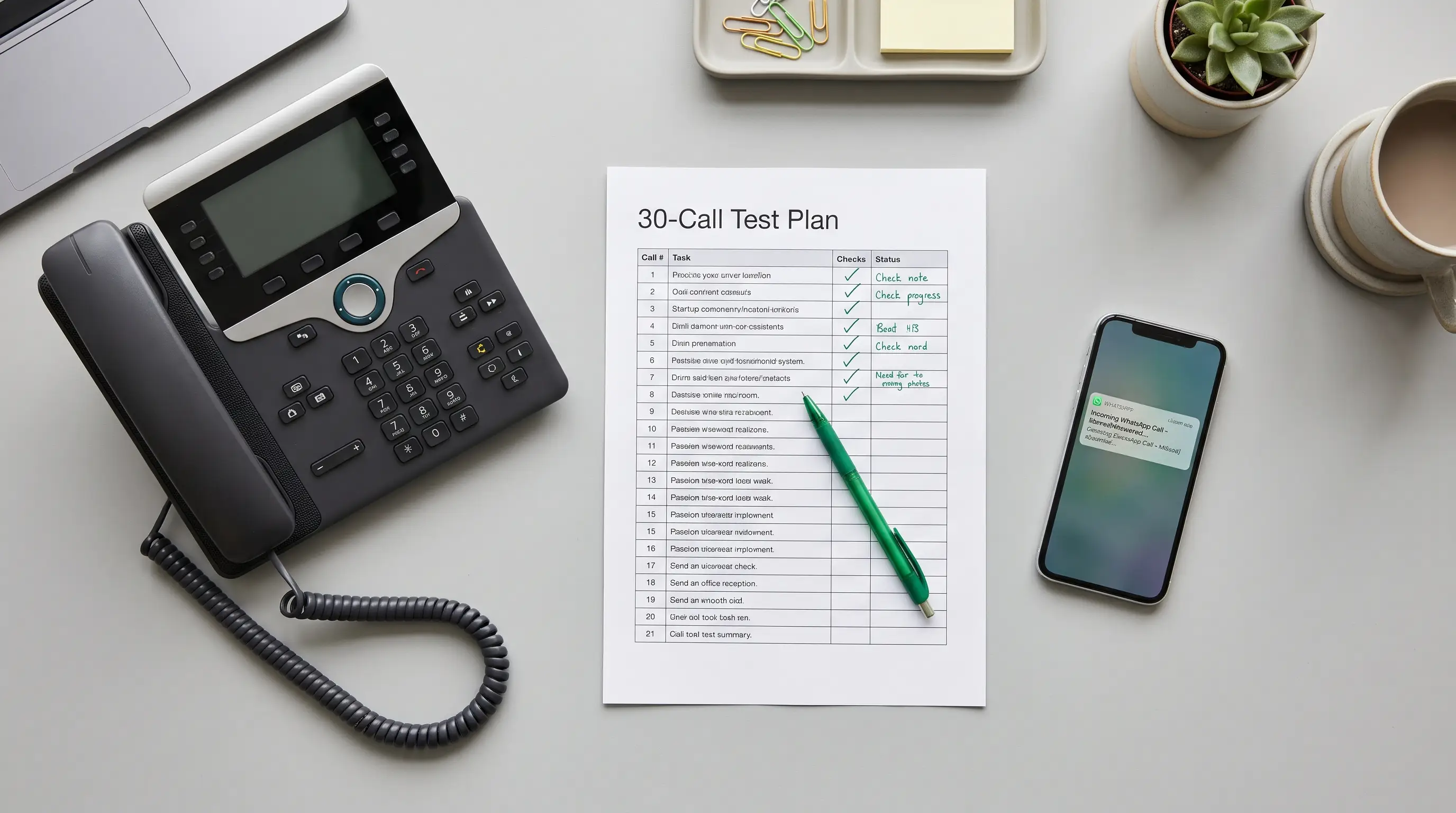
Set the pass mark before you start
A rule of thumb, written down first:
- Must-never and handoff calls: 100% pass. One failure means fix and re-test.
- Bookings: 100% correct dates in the calendar. A wrong date costs more than a missed call.
- Common questions: 9 of 10. Off-script: 4 of 5. A clumsy answer is fine if it is correct and offers a person.
Keep one row per call on a shared sheet, like this:
| Call | Script | Expected result | Conversation | Action | Follow-up |
|---|---|---|---|---|---|
| B3 | “Can I come in tomorrow at 10?” at 7:30 AM | Booked for the next calendar day, full date read back | Pass | Fail: booked today | Pass |
The three tests owners usually skip
1. Dates that need today’s date
AI models do not know today’s date unless the platform tells them. Without it, “tomorrow” can land in the wrong week, or even the wrong year. ElevenLabs, for example, offers a built-in current date and time value (we are an ElevenLabs reseller), but two things must be right:
- It must be added to the agent’s instructions. Having the feature is not the same as using it.
- The time zone must be set to Malaysia. If it is left blank, it falls back to UTC (world standard time), which is 8 hours behind us. Between midnight and 8 AM it still thinks it is yesterday, so “tomorrow” gets booked as today.
Ask your vendor to make the agent check the date before every booking, and to read the full date back (“Friday, 20 November”), because “next Friday” means different days to different callers. Then test early in the morning, late at night, on the last day of the month and before a public holiday.
2. Handoffs at 10 AM and at 10 PM
A handoff (passing the caller to a real person) is only as good as the person on the other end. Handoff rules are usually a phone number plus a plain description of when to use it, as in ElevenLabs’ transfer to human feature, and the AI decides when a call meets each rule.
Set one rule per situation (complaint, refund, urgent problem), plus a separate after-hours route: take a detailed message, promise a callback time, or send urgent calls to an on-call mobile. Then test every rule twice, in office hours and after hours. Also let one transfer ring out on purpose. Does the call go back to the AI, to voicemail, or just drop? Transfers usually need a real phone line, so make all five handoff tests over one.
3. The after-call chain
After every test call, check what landed where:
- Is the booking in the calendar, with the caller’s name and number?
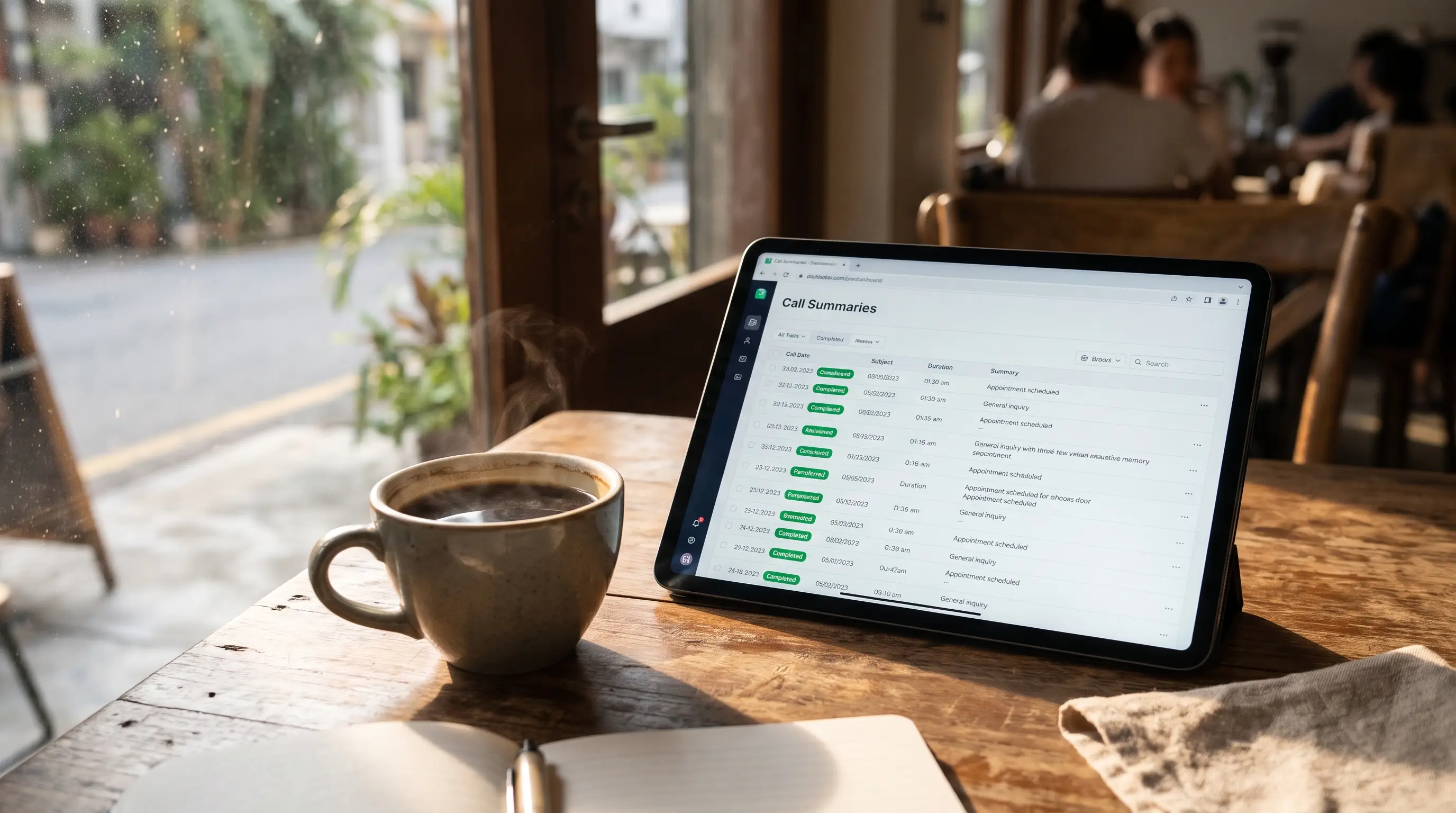
- Did the summary reach a person who will act on it, on a channel they check (WhatsApp, email or your helpdesk)?
- Does the summary match what you actually said?
Also leave out your phone number on one call, and check the summary flags it as missing.
A worked example: what testing really costs
An illustrative example for a small clinic (not client results):
- Test calls: 30 calls at about 3 minutes each is 90 minutes.
- Checking results: about 2 minutes per call to check the calendar, the summary and the score sheet is 60 minutes.
- One round: about 2.5 hours. Plan on two or three rounds, and plan as if the first round will find something to fix.
Total: 5 to 7.5 hours. At a staff cost of RM25 an hour, that is RM125 to RM187.50, less than one lost RM200 treatment. If testing prevents a single wrong-day booking, it has paid for itself.
Who is involved: the owner sets the must-never list and pass marks, front-desk staff write and make the calls, whoever receives handoffs confirms they arrive, and the vendor fixes and re-tests.

Use the platform’s own test tools too
In a simulation test, another AI plays the caller and the result is scored against goals you set. ElevenLabs’ agent testing feature offers simulation, next-reply and tool-call tests (a tool call is the agent taking an action, such as booking or transferring). These are quick for re-checking every change. But simulations can use a pretend calendar instead of your real one, so a pass does not prove a booking landed. Real calls still matter.
Other voice platforms offer similar test tools, and the right fit depends on your languages, phone setup and calendar.
Go live in stages, not all at once
Passing earns a soft launch: the AI receptionist takes only a small slice of real calls. Two good first slices:
- Overflow only: calls staff cannot pick up within a few rings.
- After hours only: calls that would go to voicemail anyway.
Illustrative numbers: if you get 40 calls a day and 6 go unanswered, overflow-only means the AI handles about 6 calls a day. Over five working days that is about 30 real calls, few enough to review every one in week one. Turn each new mistake into a new test call.
Reading yesterday’s calls over morning coffee beats wondering at midnight what it told a customer.
What can go wrong in the first month
| Problem | Early warning sign | Fix |
|---|---|---|
| The AI receptionist books the wrong day | A customer arrives with no booking on record | Check the date setting and time zone, then re-run every booking test |
| Handoffs ring an empty phone | Call logs show unanswered transfers | Add an after-hours route: message or on-call mobile |
| It promises what only you can decide | Customers quote a discount or refund you never offered | Add it to the must-never list and re-test |
| Answers go out of date | Callers are told an old price or old hours | Name one person to update it whenever prices or hours change |
| Summaries go unread | Callers chase you about a callback nobody saw | Send summaries to a channel your team checks, with one named owner |
When an AI receptionist is the wrong choice
- You miss very few calls. As a rule of thumb, if fewer than two calls a day go unanswered and callers leave voicemails, a same-day callback habit is cheaper.
- Most calls need judgement. If most calls are custom quotes or sensitive cases, the AI hands nearly all of them over, adding a step without saving time.
- Nobody can take handoffs. Then the AI only collects messages faster than you can answer them.
With a simple setup, you may not need outside help at all. For the bigger question, see our guide on whether an AI receptionist is worth it for a small business. The same test-first idea applies to AI email triage.
Frequently asked questions
How long should I test an AI receptionist before going live?
About a week: two or three rounds of scripted calls, a day or two for the vendor’s fixes between rounds, then a few soft-launch days with daily reviews.
Can I test an AI receptionist without using my real phone number?
Yes, for most of it. Many platforms let you test in the browser or on a separate test number. Handoff tests and some booking tests still need a real phone line, because transfers and line quality only show up there.
What should I ask my AI receptionist vendor before signing?
Ask how it handles your time zone, what happens when a transfer is not answered, where summaries go, and whether you can trial it on your own scripts in your customers’ languages.
How often should I re-test after launch?
Re-run the full test set after any change to its instructions, prices, hours, or calendar. Between changes, review every handoff and booking call, plus about one in ten of the rest, each week.
Your pre-launch checklist
Knowing how to test an AI receptionist matters more than picking the cleverest one. Before go-live, tick off:
- 30 scripted calls, written by front-desk staff, in your customers’ languages
- Pass marks written down before the first call
- Time zone set to Malaysia and full dates read back
- Every handoff tested in and after office hours, including one that rings out
- Every booking and summary checked where it landed
- A soft launch on overflow or after-hours calls only
Our AI solutions include AI receptionists built and tested around your real calls. If you want a second pair of eyes on your test plan, talk to us about launching your AI receptionist.